
EN 397:2025 Explained: What PPE Buyers Need to Know About the New Industrial Helmet Standard
EN 397:2025 introduces Type 1 and Type 2 helmet classifications. A practical guide to the transition, electrical protection, accessory compatibility and model-specific procurement checks.
In this article +
EN 397:2025 introduces a major revision to the European standard for industrial protective helmets. The revised standard establishes Type 1 and Type 2 helmet classifications, updates impact and compatibility requirements, changes how electrical protection is addressed, and gives procurement teams a more structured basis for matching helmet performance to workplace risk.
The change is now commercially relevant in the European Union. In June 2026, EN 397:2025/AC:2025 was referenced as a harmonised standard under Regulation (EU) 2016/425. The reference to the previous EN 397:2012+A1:2012 is scheduled for withdrawal on 16 December 2027, giving manufacturers and the market a defined transition period. (European Commission --- Implementing Decision (EU) 2026/1279)
For PPE buyers, however, the practical question is not simply whether a helmet says "EN 397." The standard edition, helmet type, exact model, certificate scope, accessory configuration, intended application and supporting documentation all need to agree before an order is approved.
EN 397:2025 --- Key Facts for PPE Buyers
| Item | Buyer-Relevant Information |
|---|---|
| Current revised standard | EN 397:2025 / EN 397:2025/AC:2025 |
| Previous edition | EN 397:2012+A1:2012 |
| Product scope | Industrial protective helmets |
| EU regulatory framework | Regulation (EU) 2016/425 |
| Harmonised reference published | June 2026 |
| Previous reference withdrawal date | 16 December 2027 |
| New helmet classification | Type 1 and Type 2 |
| Major procurement impact | Performance level, retention, accessories and intended use require closer specification |
EN 397:2025 covers requirements for the design, performance, testing and marking of industrial protective helmets. Additional performance requirements apply only where specifically claimed by the manufacturer; they should therefore not be assumed for every helmet carrying an EN 397 reference. (BSI --- Industrial Protective Helmets)
Why Does EN 397:2025 Matter to PPE Buyers Now?
EN 397:2025 matters because the revised standard is now referenced within the EU harmonised-standards framework, while the previous EN 397:2012+A1:2012 reference remains in a transition period until 16 December 2027.
Under Article 14 of Regulation (EU) 2016/425, conformity with a harmonised standard whose reference has been published in the Official Journal can provide a presumption of conformity with the relevant essential health and safety requirements covered by that standard. (European Commission --- Implementing Decision (EU) 2026/1279)
That does not mean every helmet certified or manufactured against the previous edition suddenly became unacceptable when the new reference was published.
It also does not mean procurement teams should ignore the revision until the end of 2027.
The practical response is to begin distinguishing between:
- helmets associated with EN 397:2012+A1:2012;
- helmets assessed against EN 397:2025;
- Type 1 and Type 2 configurations;
- additional performance claims;
- accessories evaluated with the helmet system;
- and the exact documentation supporting the model being purchased.
A purchase specification that simply says "CE EN 397 helmet required" is increasingly incomplete.
A stronger RFQ should identify the applicable edition or project requirement, intended application, helmet configuration, accessory requirements and model-specific evidence.
What Changed in EN 397:2025?
One of the most significant structural changes is the introduction of two helmet types.
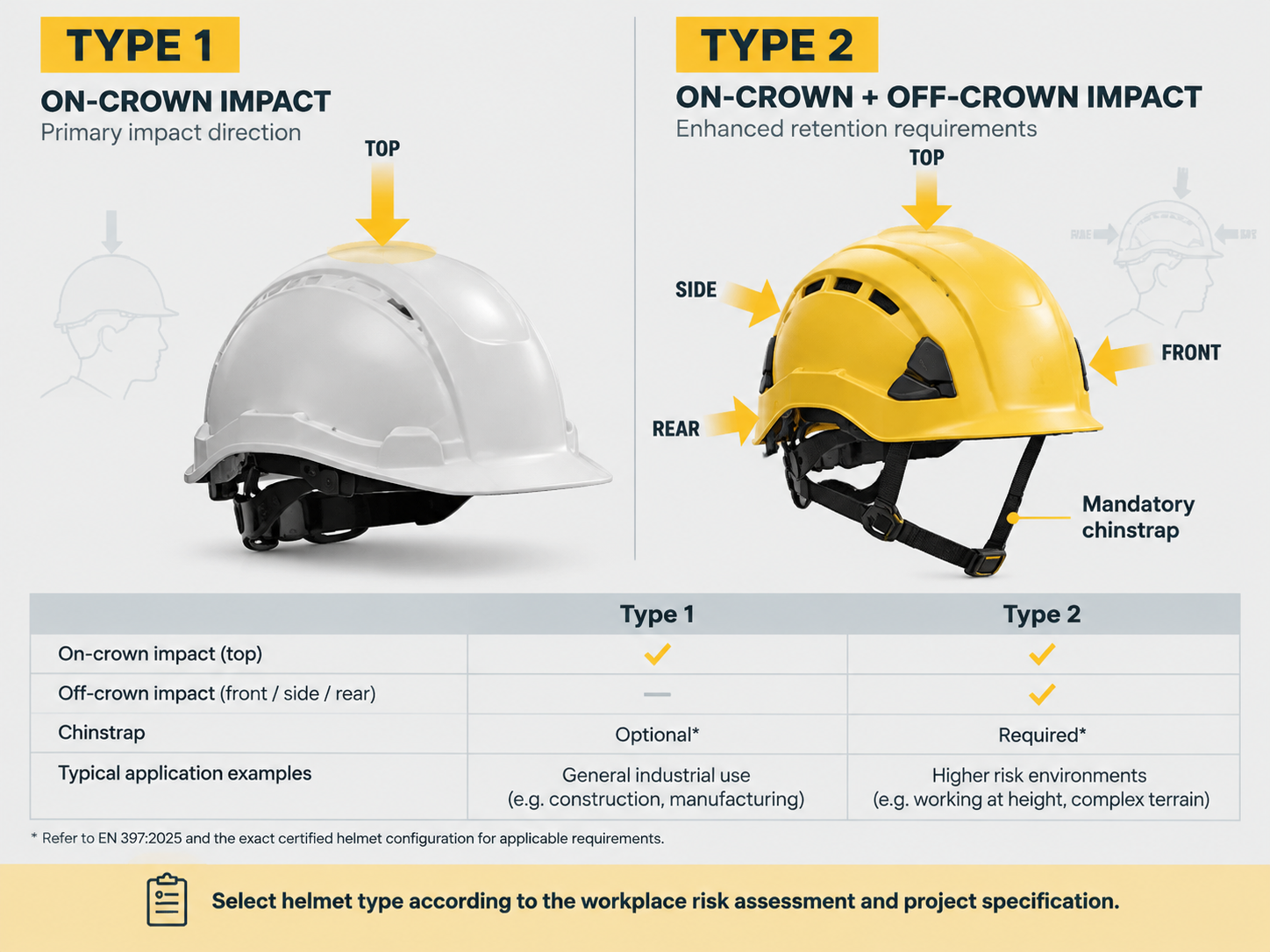
BSI describes Type 1 as providing primarily on-crown impact protection, broadly corresponding to the traditional industrial helmet concept, while Type 2 extends mandatory impact protection to on-crown and off-crown directions. Type 2 also introduces stronger helmet-retention requirements. (BSI --- EN 397 Transition Guidance)
EN 397:2012 and EN 397:2025 at a Glance
| Procurement Point | EN 397:2012+A1:2012 | EN 397:2025 |
|---|---|---|
| Basic helmet classification | One general framework | Type 1 and Type 2 |
| On-crown impact | Required | Required |
| Off-crown impact | Not structured as the new Type 2 classification | Required for Type 2 |
| Chinstrap | Previous retention framework | Requirements depend on helmet type |
| Accessory compatibility | Less explicit system assessment | Enhanced compatibility assessment |
| Electrical option | 440 V AC optional requirement existed | 440 V AC option removed |
| Electrical insulating helmet route | Previously could involve EN 397 optional marking | EN 50365 should be considered for electrical insulation |
| Testing methodology | Previous procedures | Updated impact, conditioning and measurement methods |
The revised structure is important because it discourages buyers from treating all EN 397 helmets as technically interchangeable.
What Is an EN 397:2025 Type 1 Helmet?
An EN 397:2025 Type 1 helmet is intended primarily to provide protection against on-crown impact and represents the performance route closest to the traditional industrial safety helmet concept.
BSI's technical guidance identifies a 49 J on-crown impact test energy for Type 1 helmets and notes that a chinstrap is optional within the Type 1 framework. (BSI --- EN 397 Transition Guidance)
Type 1 may be relevant to many conventional industrial applications, including:
- construction;
- manufacturing;
- warehousing;
- industrial maintenance;
- logistics;
- infrastructure work.
However, the work sector alone should not determine helmet selection.
A construction worker does not automatically require Type 1 simply because the workplace is a construction site. The correct starting point remains the project risk assessment, employer requirement, applicable regulations and site specification.
If the identified hazards include a meaningful risk of off-crown impact, loss of the helmet during a fall or another application-specific requirement, procurement should evaluate whether a different helmet configuration or performance level is required.
What Is an EN 397:2025 Type 2 Helmet?
Type 2 helmets extend mandatory impact protection beyond the crown of the helmet to off-crown impact directions and require a more robust retention arrangement.
BSI identifies Type 2 testing with 98 J on-crown impact energy and 24.5 J off-crown impact energy, with impact protection addressing the crown, front, sides and rear. A chinstrap is mandatory for Type 2 and is subject to stronger retention requirements than the Type 1 configuration. (BSI --- EN 397 Transition Guidance)
This can make Type 2 particularly relevant where the risk assessment identifies multi-directional impact or helmet-retention concerns.
Potential applications may include certain:
- work-at-height activities;
- scaffolding operations;
- utilities work;
- infrastructure maintenance;
- confined or restricted work environments;
- industrial access activities.
The important word is may.
Type 2 should not automatically be marketed as "the helmet for working at height." Helmet selection must still be based on the actual hazard profile and project requirement.
Likewise, a Type 2 classification does not mean the helmet is universally "better" than Type 1. A higher or broader performance profile is useful only when it matches the relevant risk.
For procurement teams, the correct question is:
Which helmet type corresponds to the documented risk and required use --- not which type sounds more advanced?
Is EN 397 Type 2 the Same as EN 12492?
No. EN 397:2025 Type 2 and EN 12492 remain separate standards and should not be treated as interchangeable.
The appearance of some modern industrial Type 2 helmets may resemble climbing or mountaineering helmets, and there can be overlap in the kinds of work environments where users consider these products.
That visual similarity does not establish equivalent certification.
EN 397 addresses industrial protective helmets, while EN 12492 applies to helmets for mountaineers. In the same 2026 EU harmonisation update, the revised EN 12492:2025 was also referenced, with the previous EN 12492:2012 reference scheduled for withdrawal on 16 December
Procurement teams should therefore avoid descriptions such as:
"EN 397 Type 2 is basically EN 12492."
Instead, specify the standard required by the risk assessment, tender or responsible safety function and verify evidence against the exact product model.
How Has Helmet and Accessory Compatibility Changed?
Helmet compatibility is one of the areas where EN 397:2025 has practical implications for professional buyers.
Modern industrial head protection is frequently used as a system rather than as an isolated helmet. Common configurations can include:
- safety helmets;
- chinstraps;
- safety visors;
- face shields;
- helmet-mounted earmuffs;
- eye protection;
- other approved accessories.
BSI notes that the revised standard introduces more rigorous assessment of compatibility between helmets and associated PPE such as visors, face protection and ear defenders. (BSI --- EN 397 Transition Guidance)
This is particularly important in bulk procurement.
A helmet slot that physically accepts an earmuff attachment does not, by itself, prove that the complete configuration has been assessed as a compatible protective system.
Similarly, two accessories that appear mechanically interchangeable should not be substituted without reviewing the helmet manufacturer's approved configuration and relevant documentation.
A procurement specification should therefore identify not only the helmet but also the intended system:
Helmet + chinstrap + visor + hearing protection + other required accessories
Where compatibility is critical, request model-specific information before approving production.
Does EN 397:2025 Provide Electrical Insulation?
EN 397:2025 should not be treated as evidence that a helmet is suitable for live electrical work.
A significant change in the revision is the removal of the previous 440 V AC electrical insulation option from EN 397.
BSI specifically distinguishes EN 397:2025 from EN 50365:2023, which addresses electrically insulating helmets for live working. (BSI --- EN 397 Transition Guidance)
EN 50365:2023 specifies electrical requirements and testing for helmets intended to provide electrical insulating protection when working live or near live parts within its defined voltage limits. It also defines electrical classifications and specific marking requirements. (EN 50365:2023 --- standard information)
This distinction matters for electrical utilities, maintenance contractors and industrial projects.
A buyer should not ask only:
"Is the helmet EN 397?"
Where electrical hazards are present, the more appropriate questions include:
- Is electrical insulation actually required by the risk assessment?
- Which electrical helmet standard is specified?
- Which voltage class is required?
- Does the exact helmet model carry the required evidence and markings?
- Are mechanical and electrical protection requirements both addressed?
Electrical protection is a separate technical issue and should not be inferred from the general industrial helmet standard.
Are All Additional EN 397:2025 Performance Features Mandatory?
No.
EN 397 includes additional performance provisions that apply only when the manufacturer claims them.
The revised standard includes changes involving areas such as electrostatic performance, visibility, impact testing, conditioning and accessory compatibility. (BSI --- EN 397 Transition Guidance)
This is another reason buyers should avoid treating "EN 397:2025" as a complete performance specification.
If a project requires a particular optional characteristic, include it explicitly in the purchase specification and confirm that the selected model's documentation supports that claim.
A catalogue description should never be used as a substitute for the applicable evidence.
Technical Note: EN 397:2025 Is Harmonised With a Specific Restriction
The European Commission's 2026 harmonisation decision includes a technical restriction relating to EN 397:2025.
The Commission identified a clause-reference issue and a missing link between one provision of the standard and a particular essential health and safety requirement under Regulation (EU) 2016/425. The harmonised reference was therefore published with a restriction. (European Commission --- Implementing Decision (EU) 2026/1279)
This does not mean EN 397:2025 is generally invalid.
For compliance teams, it means the Official Journal reference and associated notice should be considered together with the standard, particularly when determining the precise scope of presumption of conformity.
For ordinary procurement, the practical lesson is simpler:
Do not assess compliance only from a standard number printed on a quotation. Review the exact product evidence and applicable regulatory context.
Is EN 397:2012 Still Valid in 2026?
The previous EN 397:2012+A1:2012 reference remains within a defined EU transition period. Its harmonised-standard reference is scheduled for withdrawal on 16 December 2027. (European Commission --- Implementing Decision (EU) 2026/1279)
This is an important distinction.
The publication of a revised standard does not automatically require every helmet already in warehouses, distribution networks or workplaces to be discarded.
At the same time, buyers planning longer-term contracts should understand which standard edition the proposed product is being assessed against and how the manufacturer's transition plan affects future supply.
For framework agreements, tenders and multi-year distribution programmes, this should be addressed before the purchase specification is frozen.
Do Existing EN 397 Certificates Automatically Become Invalid?
No. Buyers should not determine certificate validity solely from the year shown after the standard number.
Under Regulation (EU) 2016/425, an EU type-examination certificate identifies the PPE type, notified body, manufacturer, applicable standards or technical specifications, performance information where relevant, issue date and expiry date. Newly issued or renewed certificates may have a validity period of up to five years. (Regulation (EU) 2016/425)
For a commercial document review, buyers should check the exact certificate rather than making assumptions.
At minimum, verify:
- the helmet model or type number;
- certificate holder;
- notified body;
- referenced standard edition;
- issue date;
- expiry date;
- covered configuration;
- relevant additions or revisions;
- corresponding Declaration of Conformity;
- product markings;
- user instructions.
A certificate that looks authentic but belongs to another model is not valid evidence for the helmet being purchased.
Likewise, a sourcing company should not replace the actual certificate holder's identity with its own corporate name.
What Should Buyers Check Before Ordering EN 397 Helmets?
A structured RFQ reduces both technical ambiguity and commercial rework.
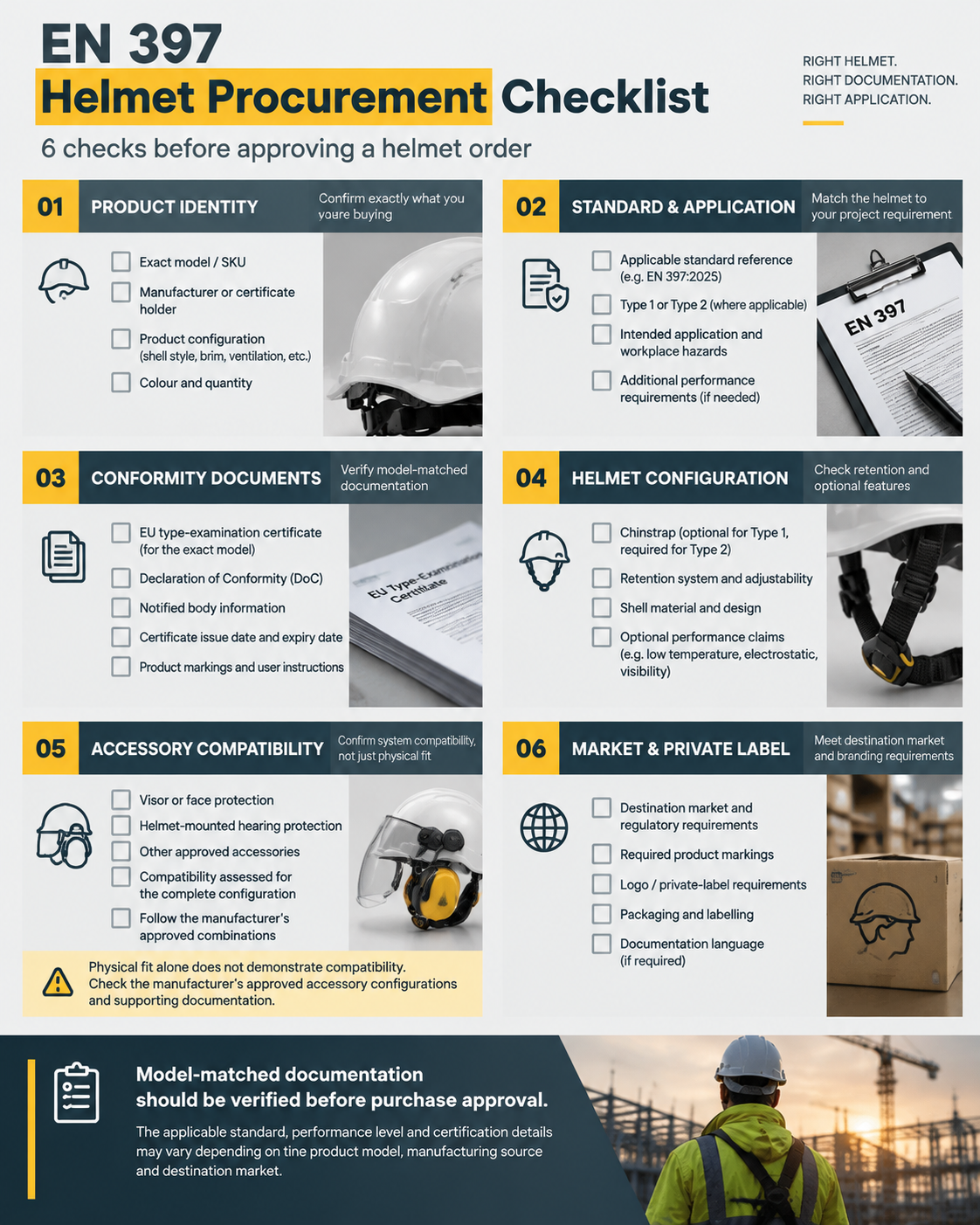
EN 397 Helmet Procurement Checklist
1. Exact product model
Record the SKU, model designation and configuration being quoted.
2. Destination market
Confirm where the helmet will be placed on the market and used.
3. Applicable project requirement
Identify the regulation, standard, tender specification or employer rule that controls selection.
4. Standard edition
Clarify whether the requirement refers to EN 397:2025, the previous edition during transition, or another helmet standard.
5. Helmet type
Where EN 397:2025 applies, confirm whether Type 1 or Type 2 is required.
6. Intended application
Document the relevant impact, retention, work-at-height, environmental and task-specific hazards.
7. Retention configuration
Confirm the required chinstrap and helmet retention arrangement.
8. Accessory system
List required visors, face protection, earmuffs and other helmet-mounted accessories.
9. Compatibility evidence
Confirm that the proposed accessories are appropriate for the exact helmet configuration.
10. EU type-examination documentation
Review the document against the product model rather than the supplier name alone.
11. Certificate holder
Keep the actual manufacturer or document holder clearly identified.
12. Notified body details
Confirm the organization responsible for the relevant conformity assessment.
13. Declaration of Conformity
Check that model identity and standard references remain consistent.
14. Product markings
Compare approved helmet markings with the certificate, instructions and commercial specification.
15. Optional performance claims
Do not assume electrical, visibility, electrostatic or other optional performance characteristics unless supported.
16. Private-label requirements
Confirm that logo, labels, packaging and other customization do not conflict with required regulatory markings or the approved product configuration.
Example: Buying 5,000 Helmets for an EU Construction Project
Consider a distributor sourcing 5,000 industrial safety helmets for a European construction programme.
The original request might read:
"Please quote 5,000 pcs CE EN 397 helmets with logo."
That is not enough information for a controlled procurement process.
A stronger specification would identify:
- destination country;
- project or employer safety requirement;
- EN 397 edition;
- Type 1 or Type 2 where applicable;
- helmet style;
- chinstrap requirements;
- visor requirements;
- helmet-mounted hearing protection;
- colour allocation;
- logo artwork;
- regulatory markings;
- required document set;
- quantity per colour;
- packaging configuration;
- sample approval requirements.
This changes the conversation from "Do you sell an EN 397 helmet?" to:
"Can this exact helmet configuration satisfy the defined project requirement, and can the corresponding evidence be verified before order approval?"
That is a much more useful B2B purchasing question.
Sourcing EN 397 Industrial Helmets Through Ecofort Safety
Ecofort Safety coordinates industrial PPE sourcing through qualified manufacturing partners, including front-brim safety helmets, full-brim configurations, climbing-style designs and compatible head-protection accessories.
Product catalogue references should be treated as the beginning of the verification process rather than final proof of conformity.
For a defined sourcing project, Ecofort can coordinate:
- product-model selection;
- target-market requirements;
- required helmet configurations;
- accessory requirements;
- private-label options;
- product-specific documentation;
- certificate-holder information;
- declarations and instructions;
- packaging and export requirements.
Standards references and product documents remain tied to the applicable model, manufacturing source and certificate holder. Ecofort does not present partner-factory certificates as Ecofort corporate certificates. (Ecofort Safety --- Compliance)
Related Ecofort Resources
- Head Protection --- browse industrial helmet configurations and model references.
- EN 397 vs ANSI Z89.1: What PPE Buyers Need to Know --- compare European and US helmet procurement requirements without treating standard names as interchangeable. (Read the comparison)
- How to Choose Head Protection for Construction Projects --- translate project hazards and site requirements into a helmet specification. (Read the guide)
- PPE Compliance & Product Documentation --- review model identity, certificate holder, standards references and supporting evidence before order approval. (Compliance Center)
Frequently Asked Questions
Is EN 397:2012 still valid in 2026?
The previous EN 397:2012+A1:2012 harmonised-standard reference is in a transition period. Its reference is scheduled for withdrawal from the EU harmonised standards list on 16 December 2027. Product and certificate status should still be assessed against the exact model and supporting documentation. (European Commission --- Implementing Decision (EU) 2026/1279)
What is the difference between EN 397 Type 1 and Type 2?
Type 1 primarily addresses on-crown impact protection. Type 2 extends mandatory impact protection to on-crown and off-crown directions and requires a stronger retention arrangement, including a mandatory chinstrap. (BSI --- EN 397 Transition Guidance)
Is Type 2 always better than Type 1?
No. Selection should follow the documented hazard and project requirement. Type 2 provides a broader impact and retention performance framework, but that does not mean every industrial user requires it.
Is EN 397 Type 2 the same as EN 12492?
No. They are separate standards with different scopes and should not be treated as equivalent merely because some helmet designs appear similar.
Does EN 397:2025 certify a helmet for electrical work?
No. The previous 440 V AC option has been removed from EN 397:2025. Where electrical insulation is required, buyers should review the relevant requirements of EN 50365 and the specific electrical hazard involved. (BSI --- EN 397 Transition Guidance)
Do old EN 397 certificates automatically become invalid because EN 397:2025 was published?
No. Certificate status should be checked against the specific product, certificate, validity dates, notified body information and applicable transition requirements. The standard year alone is not sufficient to determine validity.
What Should PPE Buyers Watch Next?
EN 397:2025 is already moving into a further amendment process.
BSI's standards-development record shows BS EN 397:2025/A1 entering the draft stage on 30 September 2026, with public comments scheduled to begin in December 2026. The project is expected to progress toward publication later in the development cycle. (BSI Standards Development --- BS EN 397:2025/A1)
For manufacturers, importers and distributors, this is another reason to avoid treating standards management as a one-time documentation exercise.
Long-term PPE procurement should include a process for monitoring:
- harmonised-standard updates;
- amendments and corrigenda;
- certificate renewals;
- product configuration changes;
- accessory approvals;
- model markings;
- technical-file revisions.
The objective is not to chase every standards announcement. It is to identify which changes materially affect the product actually being purchased or placed on the market.
Key Takeaway
EN 397:2025 changes industrial helmet procurement from a simple standard-reference check into a more clearly differentiated performance decision.
For buyers, three points matter most:
- Type 1 and Type 2 are not interchangeable labels. Select according to the actual risk and project requirement.
- EN 397:2025 does not by itself establish electrical-insulation suitability. Electrical applications require separate technical assessment.
- A standard reference is not product evidence. Always match the exact helmet, configuration, certificate holder, supporting documents and markings before commercial approval.
Need to Source Industrial Safety Helmets for an EU Project?
Share your destination market, intended application, quantity, required standard, helmet configuration, accessories and private-label requirements.
Ecofort Safety can coordinate suitable product options, model-matched documentation and commercial requirements with qualified manufacturing partners.
Technical References
- European Commission --- Commission Implementing Decision (EU) 2026/1279 of 12 June 2026, on harmonised standards for personal protective equipment drafted in support of Regulation (EU) 2016/425.
- Regulation (EU) 2016/425 of the European Parliament and of the Council, on personal protective equipment.
- EN 397:2025 / EN 397:2025/AC:2025 --- Industrial Protective Helmets.
- BSI --- EN 397 Transition Guidance / Shoulders-Up Safety: Breaking Down the Latest PPE Standard Revisions, 2026.
- EN 50365:2023 --- Live Working: Electrically Insulating Helmets for Use on Low and Medium Voltage Installations.
- BSI Standards Development --- BS EN 397:2025/A1 Industrial Protective Helmets, project status accessed October 2026.
Editorial note: Standards, legislation and product documentation can change. Buyers should verify the current regulatory position and model-specific documentation applicable to the destination market before purchase approval.