
Fall Protection in Remote Mountain Logistics: Rope Strength, Load Security and PPE Selection
How fall-protection ropes, energy absorbers and cargo restraints work in remote mountain logistics — and why workers, tools and loads require different safety systems.
In this article +
Fall Protection in Remote Mountain Logistics
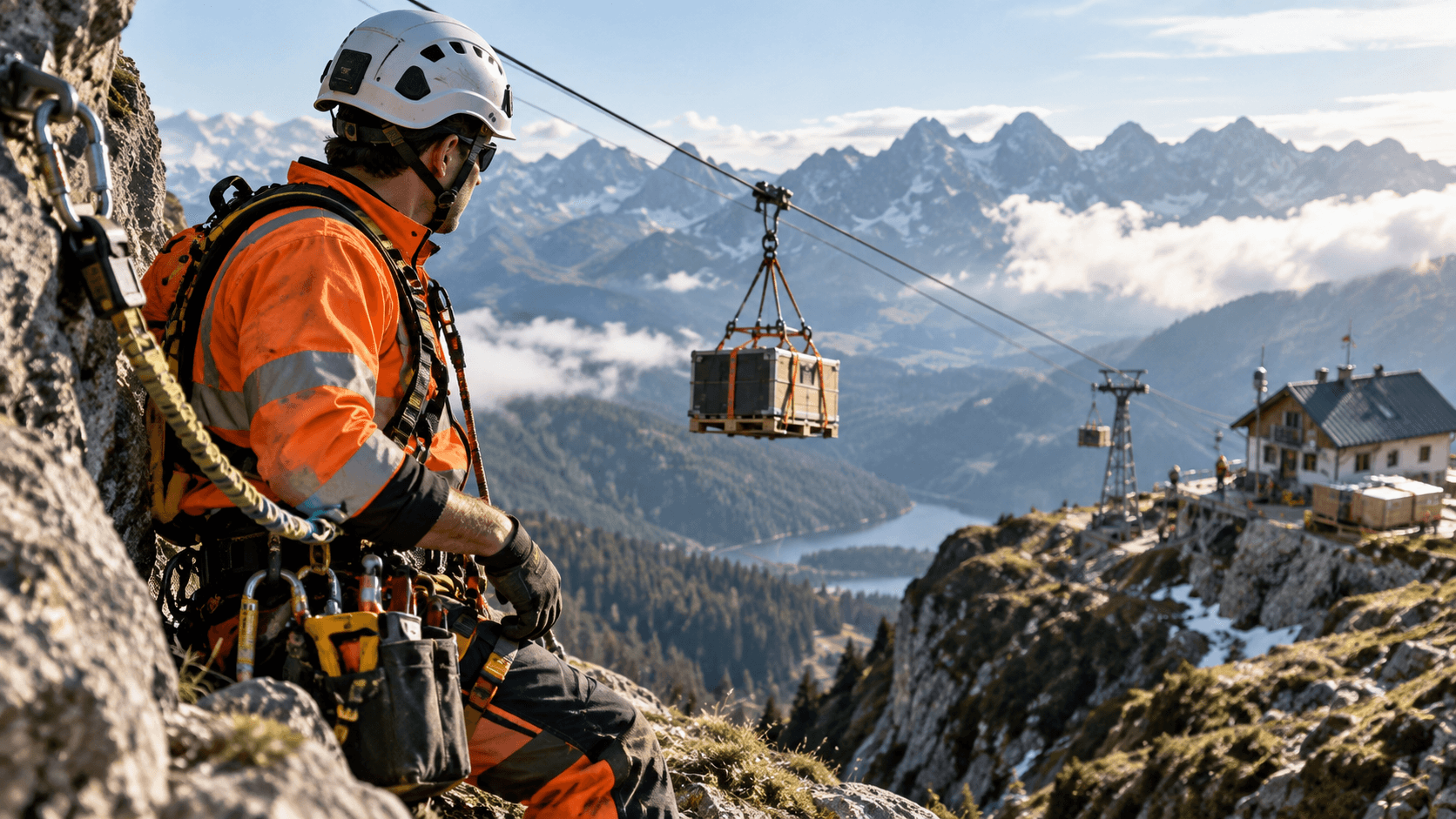
Remote mountain logistics creates three different safety problems: workers can fall, tools can be dropped, and transported loads can shift or fall.
These risks should not be controlled with the same equipment.
Personal fall-protection ropes, lanyards, harnesses and connectors are designed to protect people. Cargo requires dedicated lifting or load-restraint systems. OSHA specifically states that personal fall-protection components must be used for employee protection and not for hoisting equipment or materials.
For safety teams and PPE buyers, the key question is therefore not simply “How strong is the rope?”
The more useful questions are:
- What standard is the rope tested to?
- What load is applied during testing?
- How much does the rope elongate?
- What happens when a fall creates dynamic force?
- How strong is the rope after a knot or termination is added?
- Are the rope, connector, absorber and anchorage compatible as one system?
Key Data at a Glance
- ≥ 22 kN
- EN 1891 Type A static rope strength benchmark
- 15 kN / 3 min
- Type A strength with figure-eight terminations
- ≤ 6 kN
- Peak arrest force under specified dynamic testing
- ≥ 5 falls
- Dynamic performance under defined EN 1891 conditions
- 22.2 kN / 5,000 lb
- OSHA lanyard / vertical lifeline minimum breaking strength for covered applications
- 844
- U.S. fatal occupational falls, slips and trips in 2024
These figures are standards, regulatory and data benchmarks. They are not Ecofort product test results.
Why Fall Protection Still Matters
Falls remain one of the most serious hazards in industrial work.
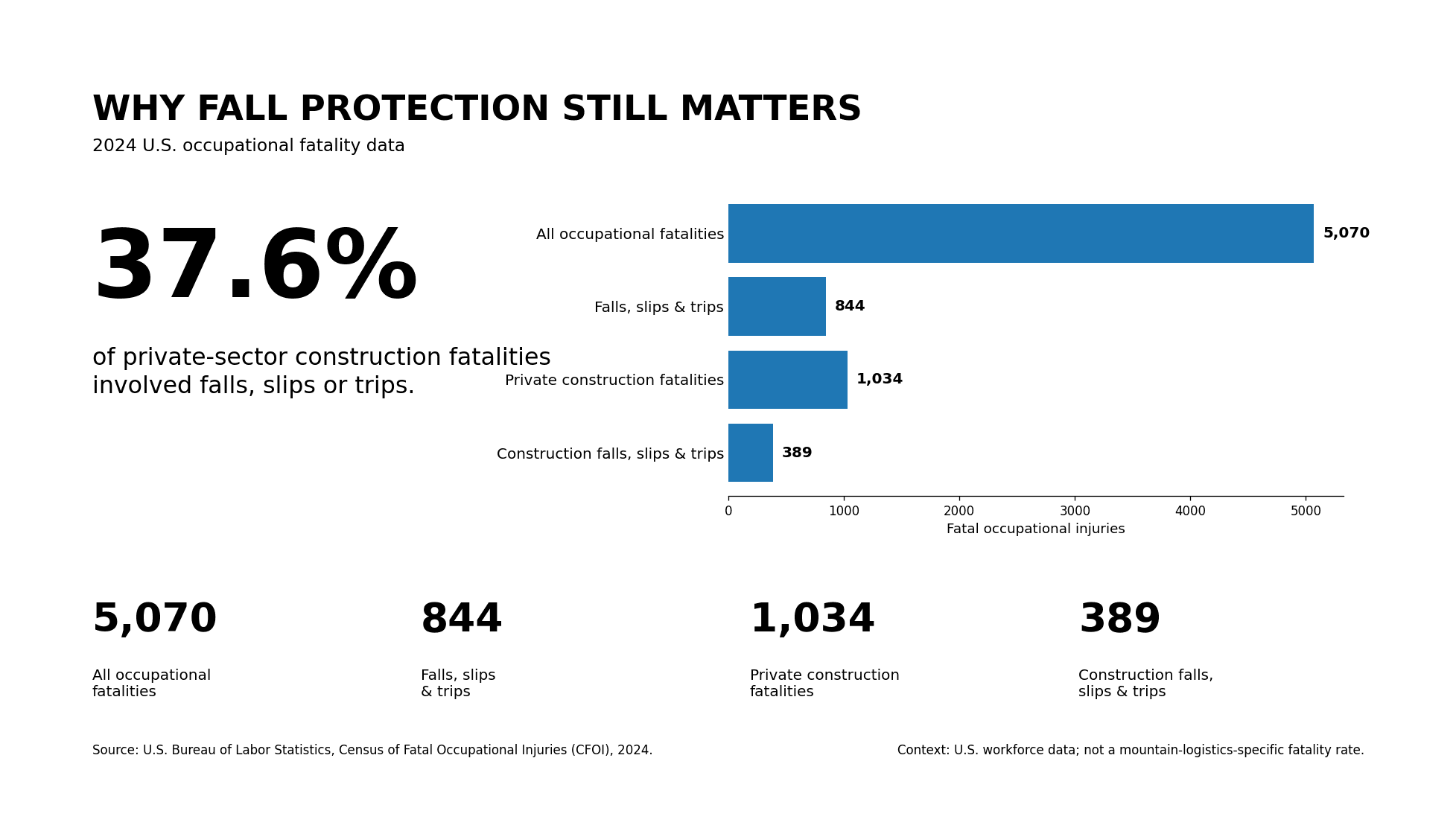
According to the U.S. Bureau of Labor Statistics, 5,070 fatal occupational injuries were recorded in the United States in 2024. Falls, slips and trips accounted for 844 deaths.
Private-sector construction recorded 1,034 workplace fatalities in 2024, with 389 deaths caused by falls, slips and trips. Of those cases, the large majority involved a fall to a lower level.
That means approximately 37.6% of private-sector construction fatalities in 2024 involved falls, slips or trips.
Mountain and remote-site work should not be treated as identical to conventional construction, but the data helps explain why fall-risk control remains fundamental wherever people work around elevation, exposed edges and difficult access.
One Mountain. Three Different Falling Risks.
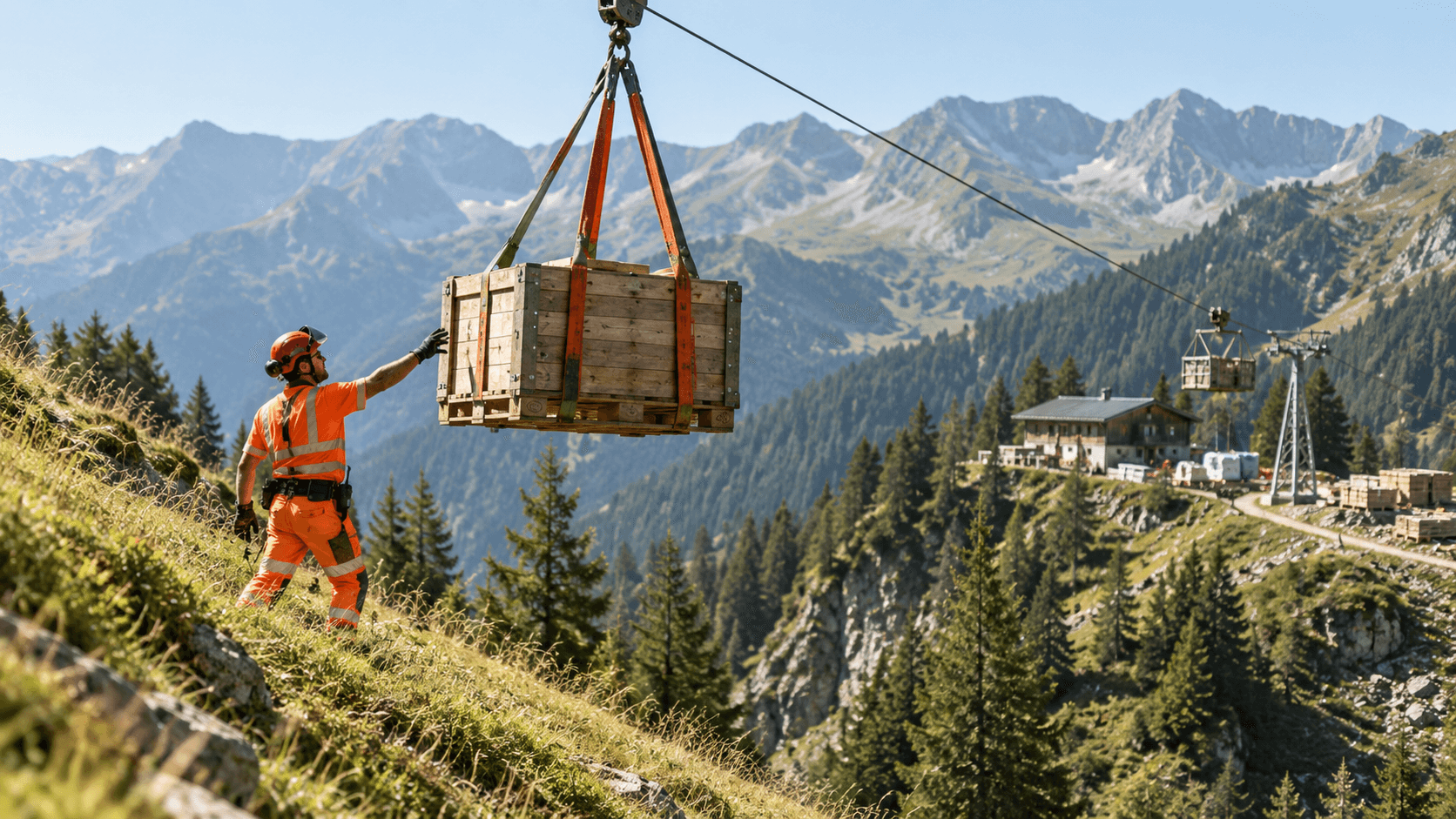
A remote worksite can place workers, tools and transported supplies in the same physical environment. Their risks may look similar, but the engineering controls are different.
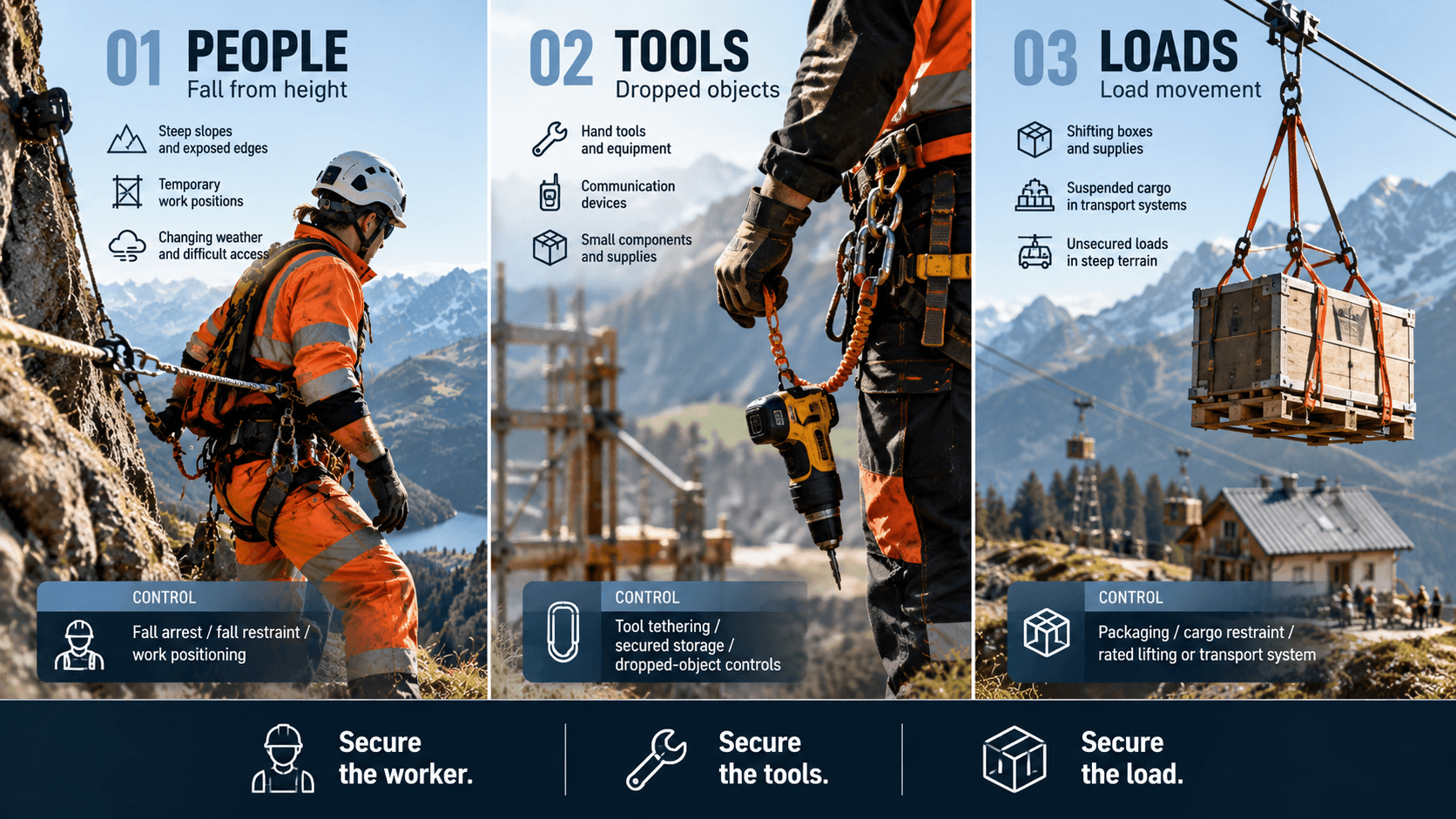
Secure the worker. Secure the tools. Secure the load. But do not assume one system can safely do all three jobs.
A personal safety lanyard should not become an improvised cargo strap simply because both products contain rope or webbing.
Mountain Logistics Is a Real Industrial Application
Remote mountain transport is not only an outdoor recreation scenario.
Europe's EN 17639:2025 addresses fixed cableway installations designed to transport material and certain designated persons. One stated application is the transport of supplies to and waste from mountain huts and shelters.
The standard reflects the reality that difficult terrain can turn a simple delivery into an engineered logistics operation. Moving supplies may involve specialized transport equipment, while workers operating around that equipment require their own PPE and fall-protection strategy.
Rope Strength Is More Than a Breaking-Load Number
A common mistake in PPE purchasing is to reduce rope quality to a single number.
For example: 22 kN.
At first glance, that looks straightforward. A buyer may assume that the higher the number, the safer the rope.
But fall protection is more complicated.
A static strength test asks whether a component can withstand a prescribed force under a particular laboratory setup. A real fall introduces movement, acceleration, elongation, terminations, connectors, anchorage and the human body.
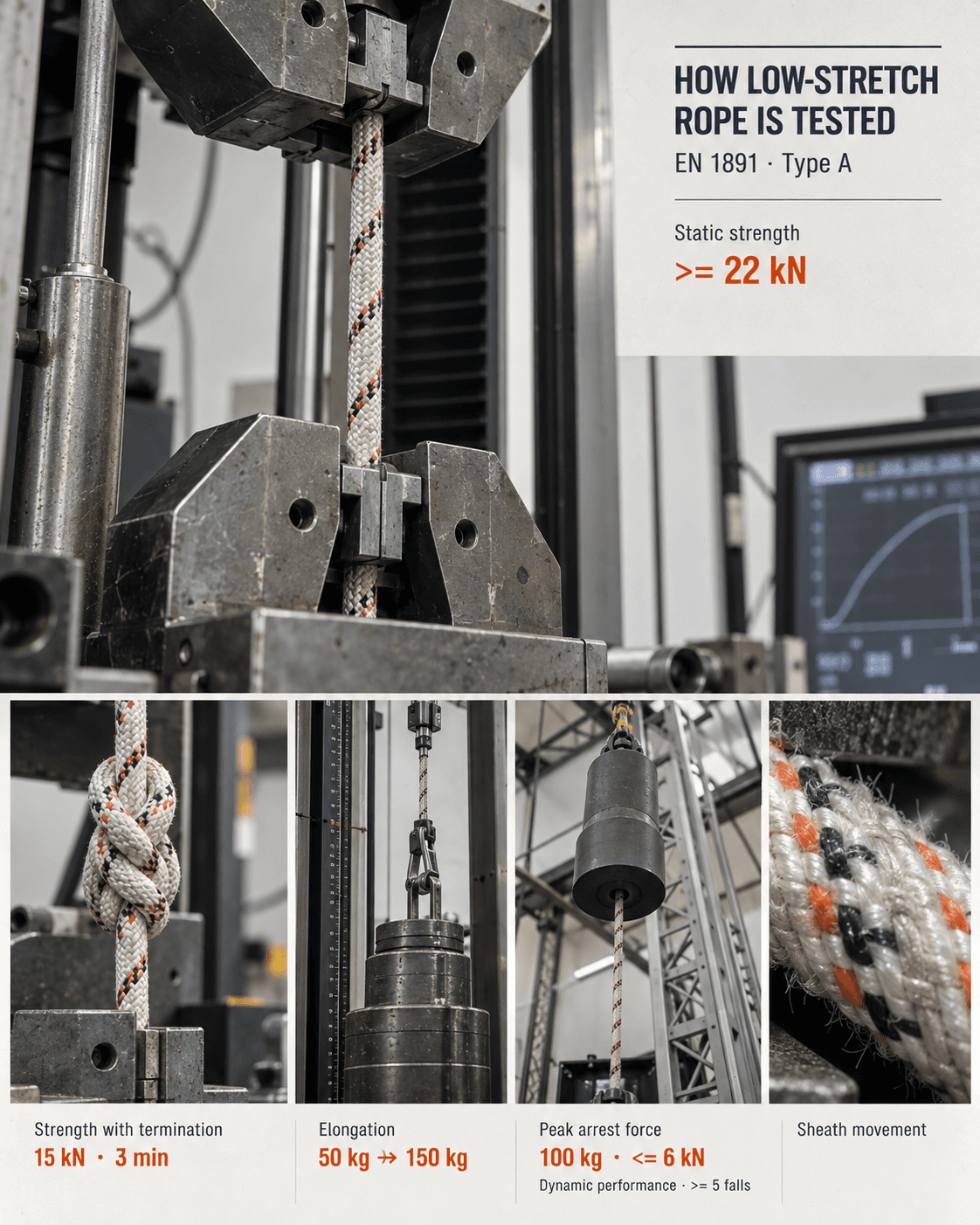
For a low-stretch kernmantle rope under EN 1891, relevant characteristics include static strength, strength with terminations, elongation, sheath movement, peak arrest force and dynamic performance.
How Is a Low-Stretch Safety Rope Tested?
1. Static Strength Without Termination
For an EN 1891 Type A low-stretch kernmantle rope, the static-strength benchmark is ≥ 22 kN. Type B has a lower requirement.
2. Strength With Rope Termination
A Type A rope fitted with figure-eight-knot terminations must withstand 15 kN for 3 minutes under the referenced EN 1891 test framework.
3. Elongation
The referenced test procedure applies 50 kg and then 150 kg under defined conditions to evaluate elongation.
4. Peak Arrest Force
For the Type A peak-force test, a 100 kg test mass is used and the measured peak arrest force must not exceed 6 kN under the defined test setup.
5. Dynamic Performance
Under the defined Type A dynamic test configuration, the rope must withstand at least 5 falls.
6. Sheath Slippage
EN 1891 also evaluates movement between the outer sheath and the core. This matters because rope quality cannot be judged by appearance, diameter or breaking strength alone.
22 kN vs. 6 kN: Why Are Both Numbers Important?
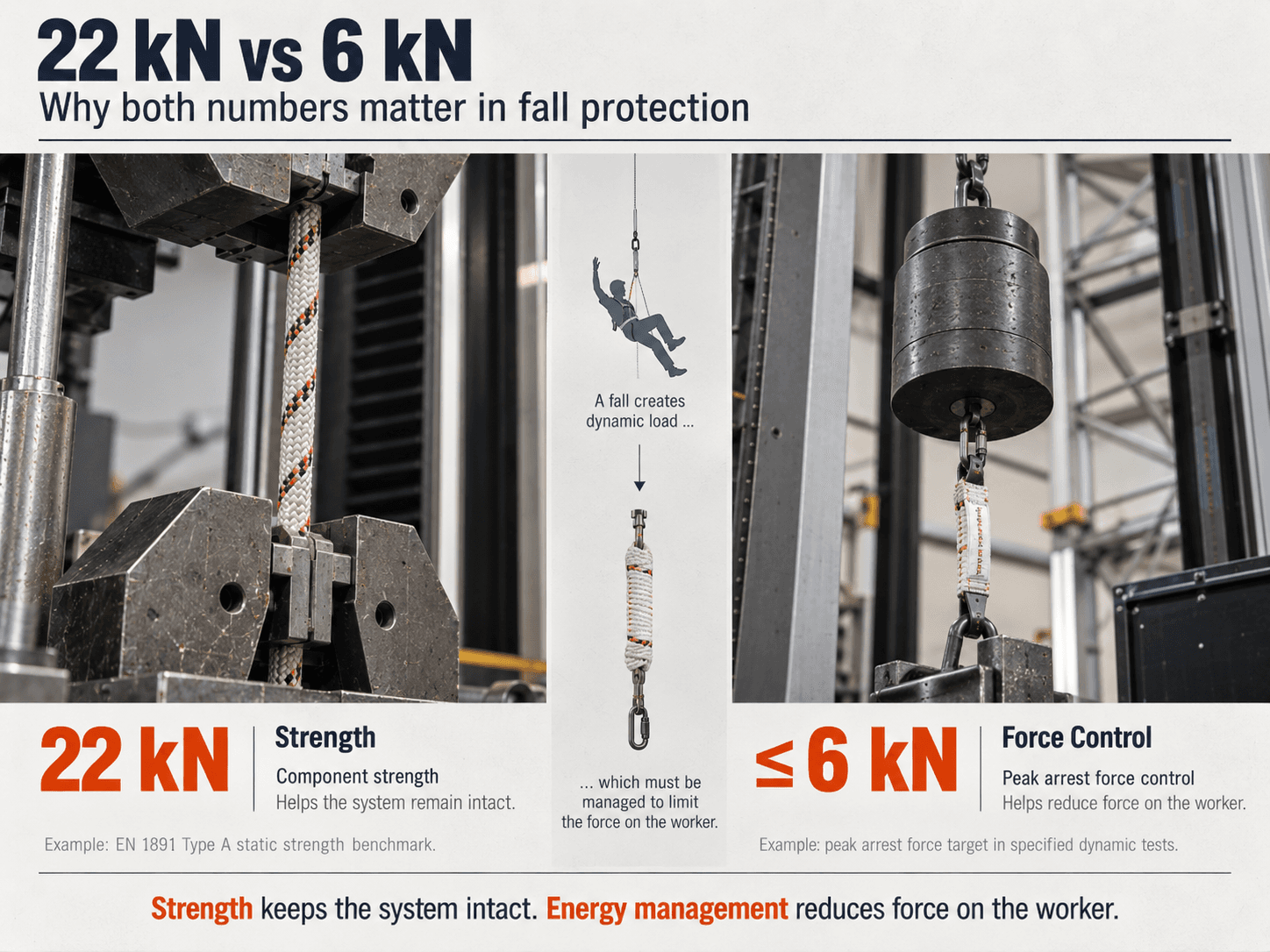
These numbers describe different engineering objectives.
Strength
The component needs sufficient mechanical strength to remain intact.
Energy Management
The fall-arrest system needs to control the energy generated when a moving body is stopped.
A very strong connection is not automatically a safe connection if the system arrests a fall too abruptly. This is why energy absorbers are used in suitable fall-protection systems.
Good fall protection requires both sufficient strength and controlled force.
A Safety System Is More Than a Rope
It is tempting to look at the rope as the main safety component. In practice, fall protection works as a system.
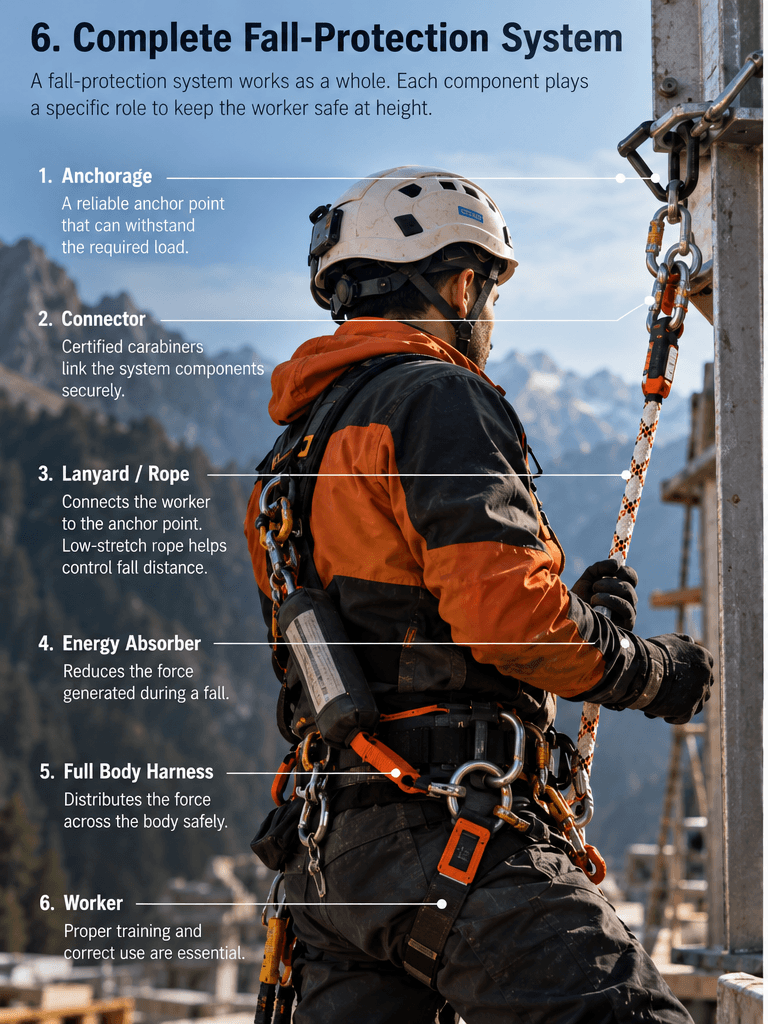
ANCHORAGE → CONNECTOR → LANYARD / ROPE SYSTEM → ENERGY MANAGEMENT → HARNESS → WORKER
Each interface matters. A strong rope connected to an unsuitable anchorage does not create a safe system. A compliant harness combined with incompatible connectors does not create a safe system. A high-strength lanyard that allows excessive fall distance does not solve the problem either.
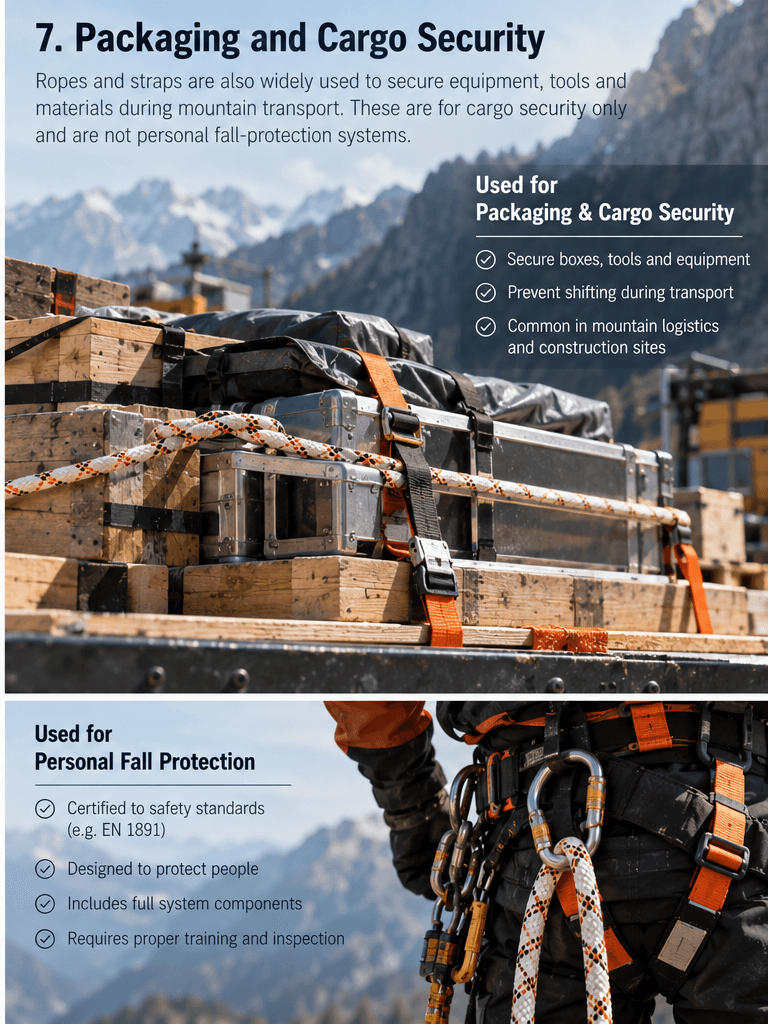
Packaging Is Part of Remote Logistics — But It Is Not Fall-Protection PPE
Packaging has a legitimate role in this story. Supplies moving into difficult terrain may experience repeated handling, vibration, stacking, moisture exposure and impact.
| System | Primary purpose |
|---|---|
| Personal fall-protection system | Protect the worker from a fall |
| Tool tether / dropped-object system | Control tools and small objects |
| Packaging | Protect the product during handling and distribution |
| Cargo restraint | Control movement of transported goods |
| Lifting / transport equipment | Move loads through the defined logistics system |
A worker's lanyard protects the worker. A tool tether controls a tool. A cargo restraint controls the load.
How Can Transport Packaging Be Tested?
Packaging also has its own test language.
ISO 2248 defines vertical impact testing for complete, filled transport packages. ISO 12048 covers compression and stacking tests. ISO 13355 covers vertical random vibration testing of filled transport packages and unit loads.
There is no single universal “mountain packaging drop height” that should be applied to every package. Test severity should be selected according to the product, package mass, distribution route, handling method and risk profile.
Use the test that matches the real application.
What Should a PPE Buyer Actually Ask a Supplier?
| Buyer question | What should be verified |
|---|---|
| What is the intended application? | Fall arrest, restraint, work positioning, rope access or another defined use |
| What standard applies? | Exact standard and edition where relevant |
| What product was tested? | Rope, terminated rope, complete lanyard or complete subsystem |
| What model does the report cover? | Commercial model should correspond to documentation |
| What is the static-strength result? | Test method, configuration and result |
| What is the dynamic-performance result? | Test mass, fall configuration and measured result |
| How was the rope terminated? | Knot, sewn termination or manufacturer-specific construction |
| What connectors are included? | Applicable standard, strength values and correct loading direction |
| Is an energy absorber required? | Depends on the system and intended use |
| What anchorage is required? | Must match the applicable system design |
| What inspection instructions are supplied? | Pre-use inspection, retirement criteria and damage checks |
| What traceability is provided? | Manufacturer, model, batch/serial information and production data where applicable |
Inspection Matters After the Product Leaves the Factory
Certification does not eliminate the need for inspection.
Personal fall-protection equipment should be checked for wear, damage and deterioration before use, and equipment that has been subjected to significant impact loading should be removed from service until appropriately assessed.
Remote sites make this particularly important. Dirt, moisture, UV exposure, sharp surfaces and rough transport can affect equipment before a fall ever occurs.
The exact inspection and retirement criteria must follow the product manufacturer's instructions and applicable regulations.
Remote-Site PPE Procurement Checklist
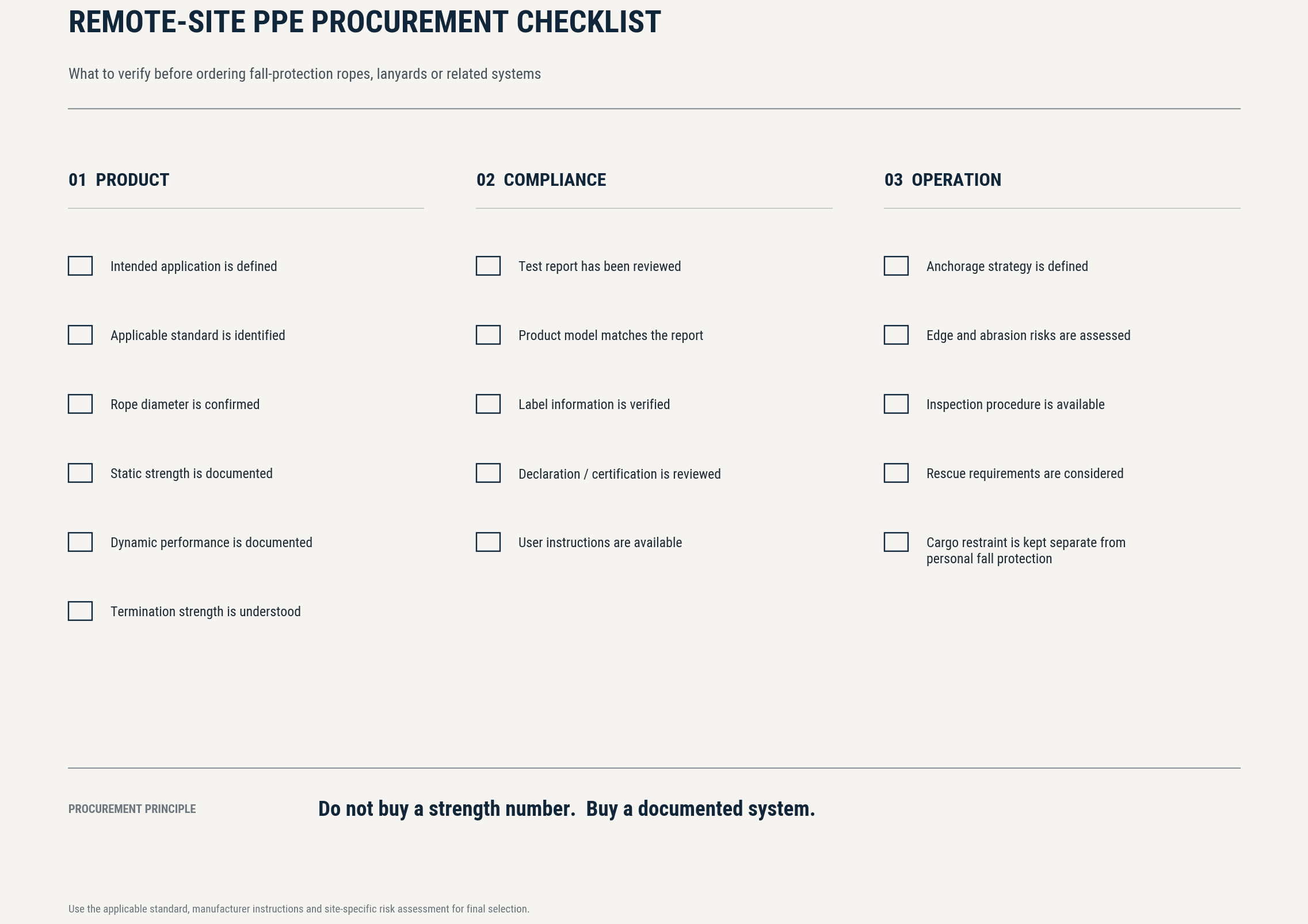
Product
- Intended application defined
- Applicable standard identified
- Rope diameter confirmed
- Static strength documented
- Dynamic performance documented
- Termination strength understood
Compliance
- Test report reviewed
- Product model matches report
- Label information verified
- Declaration or certification reviewed
- User instructions available
Operation
- Anchorage strategy defined
- Edge and abrasion risks assessed
- Inspection procedure available
- Rescue requirements considered
- Cargo restraint kept separate from personal fall protection
What Does “22 kN” Actually Mean on a Safety Rope?
A 22 kN figure describes force. It does not, by itself, describe a complete fall-protection system. For an EN 1891 Type A low-stretch kernmantle rope, the commonly referenced 22 kN figure relates to the minimum static-strength requirement for the rope without termination under the defined test procedure.
Add a termination and the test changes. Introduce a dynamic fall and the question changes again. Add connectors, an absorber, a harness and an anchorage, and the buyer is now evaluating an entire system.
22 kN is a test benchmark, not a complete definition of safe use.
Frequently Asked Questions
Can a fall-protection lanyard be used to secure cargo?
No. Personal fall-protection systems should be used for their intended personnel-protection function. Cargo requires an appropriate load-restraint, lifting or transport system.
Is a higher kN rating always better?
Not by itself. Strength is important, but fall protection also depends on dynamic force, elongation, connectors, anchorage, clearance, compatibility and intended application.
What does EN 1891 cover?
EN 1891 covers low-stretch kernmantle ropes used for personal protection against falls from height, with Type A and Type B performance categories.
Why is 6 kN important?
Six kilonewtons appears in prescribed European dynamic test limits relating to arrest-force control, including EN 1891 and EN 355 test contexts.
Does a 22 kN rope mean it can safely lift approximately 2.2 tonnes?
No. A static force rating is not automatically a safe working-load rating, lifting capacity or recommended suspended mass.
Should PPE buyers request test reports?
Yes. A useful test report allows the buyer to verify what product was tested, under which standard, in what configuration and with what result.
The Procurement Lesson: Do Not Buy a Strength Number
Mountain logistics provides a clear way to understand modern PPE.
A worker may stand beside transported cargo. Both may be connected to rope-based systems. Both may operate in the same harsh environment. But they are not the same safety problem.
The worker requires a personal protection system.
The tools require dropped-object controls.
The load requires appropriate packaging and cargo security.
And within the worker's fall-protection system, rope strength is only one part of the engineering picture.
Static strength matters.
Dynamic performance matters.
Energy absorption matters.
Terminations matter.
Connectors matter.
Anchorage matters.
Inspection matters.
Compatibility matters.
Do not buy a strength number. Buy a documented system.
Technical References
- 01EN 1891:1998 — Low-stretch kernmantle ropes
- 02EN 355:2002 — Energy absorbers
- 03EN 17639:2025 — Cableway installations for transport of material and specially designated persons
- 04OSHA 29 CFR 1910.140 — Personal fall-protection systems
- 05OSHA 29 CFR 1926.502 — Fall-protection systems criteria and practices
- 06U.S. Bureau of Labor Statistics, CFOI 2024
- 07ISO 2248:1985 — Vertical impact testing of complete transport packages
- 08ISO 12048:1994 — Compression and stacking tests
- 09ISO 13355:2016 — Vertical random vibration tests
Standards and regulations can be application-specific and may be revised. This article is intended as general procurement and safety information, not as a substitute for the complete applicable standard, manufacturer instructions, site-specific risk assessment or advice from a qualified fall-protection professional.